In previous articles, we explored the basic concepts, material properties, and core advantages of EN545 standard ductile iron pipe in the water industry. This article will delve into more specific and critical technical aspects, including ovality control in the manufacturing process, the product grade classification system, weld repair methods for defects, and important pipe connection joint types. This knowledge is crucial for engineering design, procurement selection, construction and installation, and quality control.
I. Calculation and Measurement of Ductile Iron Pipe Ovality
Ovality is an important geometric parameter that measures the deviation from roundness of a pipe. Excessive ovality can lead to poor sealing of the rubber ring, especially for pipes with spigot-and-socket joints, and can cause leakage.
Definition: Ovality is the difference between the maximum outer diameter and the minimum outer diameter of a pipe cross section. The EN545 standard specifies specific limits for ovality.
Calculation Formula: Ovality = Dmax – Dmin
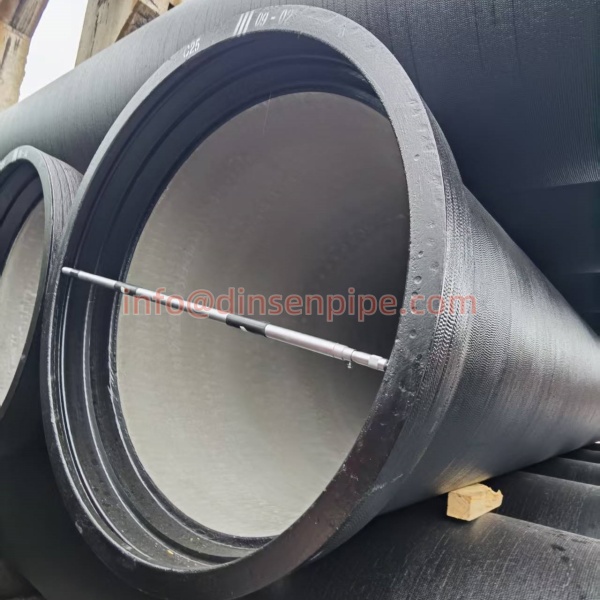
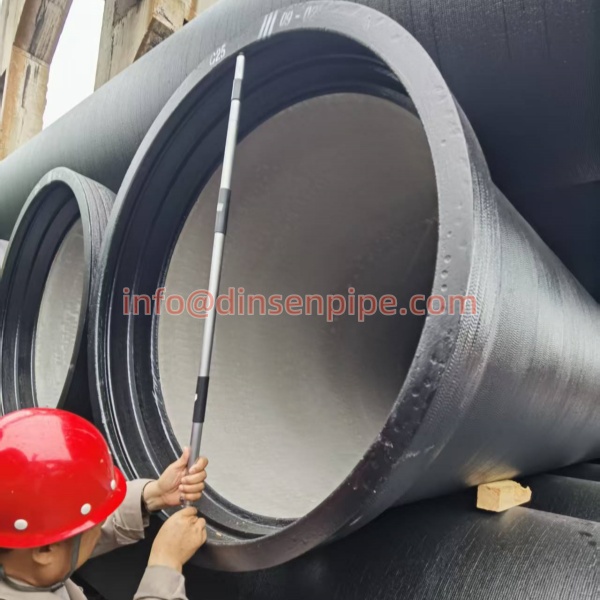
Measurement Method: A Specialized Ruler is a graduated, flexible steel strip with a specially calibrated circumference. To measure, wrap the Ruler around the pipe. The difference in the scale marks on the ruler is read to calculate the diameter of the cross section. By rotating the pipe end at multiple angles, Dmax and Dmin can be determined.
Technical requirements: The EN545 standard requires that ovality must be within the permitted range to ensure a smooth and tight connection between the socket and spigot. Typically, ovality must be strictly controlled within 100 mm from the pipe end.
II. K/C/PN/DN Classification Standards for Ductile Iron Pipes
DN: This represents the standard ductile cast iron pipe size. It is a rounded value, usually expressed in mm. It does not correspond to the actual inside or outside diameter; it is simply a designation used for identification, such as DN100, DN500, DN1000, etc.
PN: This represents the maximum allowable working pressure that the pipe and fittings can withstand at a water temperature of 20°C. The unit is bar or MPa. Common PN grades in the EN545 standard are:
- PN10: Permissible working pressure 10 bar (1.0 MPa)
- PN16: Permissible working pressure 16 bar (1.6 MPa)
- PN25: Permissible working pressure 25 bar (2.5 MPa)
- PN40: Permissible working pressure 40 bar (4.0 MPa)
When selecting a pipe, the PN value must be greater than or equal to the system’s maximum designed working pressure.
K Class – Stiffness Grade: This grade indicates the pipe’s ability to resist deformation from external soil and traffic loads, i.e., the stiffness of the pipe wall. It is defined by the radial SN of the pipe wall, expressed in N/m².
- K9: This is the most commonly used, standard stiffness grade, with a minimum stiffness of 10,000 N/m² (SN 10000), suitable for most buried applications.
- K8/K7, etc.: These grades offer lower stiffness than K9 and are used in applications with lower loads. They are relatively uncommon. K10 and above: Higher stiffness than K9, suitable for extremely deep cover or extreme load conditions.
C Class – Coating Type: Indicates the type of anti-corrosion coating applied to the pipe’s exterior, selected based on the soil corrosive environment.
- C25: Standard coating. Typically a zinc-rich primer with an asphalt finish. Suitable for general soils .
- C40: Enhanced coating. Thicker than the standard coating, or using high-performance coatings such as epoxy resin. Suitable for highly corrosive soils, swamps, or acidic environments.
- C30/C35 and other intermediate grades are intermediate grades.
General example: A ductile iron pipe marked DN500 × PN40 × K9 × C40 indicates a nominal diameter of 500 mm, a nominal pressure of 40 bar, standard stiffness, and an enhanced external anti-corrosion coating.
III. Ductile Iron Pipe Repair Methods—Welding
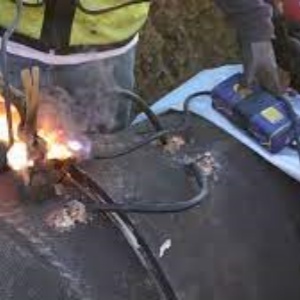
Due to the unique nature of DI pipes, welding repairs require strict adherence to procedures. These repairs are typically limited to casting defects or minor damage incurred during transportation and must be performed by qualified personnel.
Feasibility: Welding is possible, but the process requirements are extremely high, unlike those for ordinary carbon steel.
Key Difficulty: Graphite in ductile iron exists in spherical form. During welding, carbon in the heat-affected zone (HAZ) promotes the formation of high-hardness cementite, making the area brittle and susceptible to cracking.
IV. Types of Ductile Iron Pipe Joints
Flexible Joint – The most common type.
- Installation: Push the spigot end into the socket. The seal seals due to its elasticity. A certain degree of deflection (usually 3-5°) and axial displacement are permitted to accommodate foundation settlement and thermal expansion and contraction.
- Advantages: Fast installation, good flexibility, and reliable sealing.
Mechanical Joints
- Flanged Joint: A standard flange is attached to the pipe end and connected to another flange via bolts. Suitable for applications requiring frequent disassembly or connections to valves, pumps, and other equipment. It offers high rigidity and no flexibility.
- Coupling/Sleeve Coupling –This is a separate fitting with an internal rubber seal.
- Used for connecting two pipe sections with flat ends or repairing damaged pipes. During installation, a clamp is placed on the butt joint of the two pipes, and the bolts on both sides are tightened to compress the sealing ring and seal. It also allows for some deflection and expansion.
Flexible Adapter –This is a special rubber expansion joint, typically with flanges on both ends.
- It is primarily used to connect pipes of different materials (such as ductile iron and PVC) and specifications, or in applications requiring greater displacement compensation and vibration damping, such as at railroad or highway casings or at pump outlets to reduce water hammer.
Dismantling Joint –A sophisticated, specialized flange connection typically consisting of a pair of flanges, a short pipe nipple, a gland, a rubber ring, and long bolts.
- Core Function: Adjusts installation length and facilitates disassembly. The long bolt design allows the joint to be opened sufficiently after loosening the nut, making it easier to replace the valve’s sealing gasket or perform system maintenance without extensive pipe movement.
- Application: Almost always installed on both sides of valves and at the inlets and outlets of equipment requiring frequent maintenance.
#ductilecastironpipesize,#drinkingwaterpipeEN545, #rubberring, #spigotandsocketjoints, #ductileironpipe #DIpipeEN545
Post time: Sep-19-2025