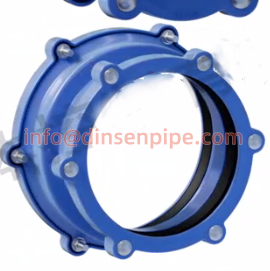
Detachable joints play a crucial role in the installation and maintenance of ductile iron pipes. They provide a flexible and reliable connection solution, particularly when connecting ductile iron pipe (DIP) to other materials, such as steel pipe, PVC pipe, valves, or fire hydrants. Detachable joints comply with European standard EN545 (Ductile iron pipe, fittings, accessories, and joints for drinking water supply) to ensure product quality and compatibility. This article will provide an in-depth understanding of two key concepts: the performance ratings of joint materials and the two main connection types.
1. Understanding the Material Designation: QT500-7
When you pick up a ductile iron dismantling fitting that complies with the EN545 standard, you’ll often see “QT500-7″ or a similar designation cast on it. This isn’t just a designation; it directly reveals the mechanical properties of the fitting’s material and is a key indicator of its quality.
- QT: This abbreviation stands for “Quenched and Tempered.” This heat treatment process transforms the graphite in cast iron from flakes to spheroids (spheroidization), significantly improving the material’s strength, toughness, and ductility. Therefore, QT also stands for “Ductile Iron” (or “Nodular Iron”).
- 500: This number represents the material’s minimum tensile strength of 500 megapascals (MPa).Tensile strength refers to the maximum stress a material can withstand under tension before breaking. 500 MPa is a high value, meaning the material is exceptionally strong, capable of withstanding the high pressures within the piping system as well as external soil loads and mechanical stresses, ensuring the structural integrity and safety of the joint.
- 7: This number represents the material’s elongation at break (Elongation at Break) of 7%. Elongation is a measure of a material’s toughness and plasticity, representing the percentage of the increase in length of a specimen at break compared to its original length. An elongation of 7% indicates the material has excellent toughness. Even with slight deformations (such as stress caused by foundation settlement or temperature fluctuations), it exhibits a certain degree of yield and deformation, which is crucial for ensuring the joint’s seal under complex operating conditions.
Simply put, QT500-7 means the joint is made of high-strength and high-toughness ductile iron. It is both “hard” and “tough,” rather than “brittle,” making it an ideal material choice for pipe connectors.
2. Two main connection types: Tyton Joint and Flanged Joint
EN545 detachable joints are primarily used to connect ductile iron pipes to fittings/equipment of different diameters or materials. The most common and representative types are the Cantonese (T-type) and stepped (F-type).
1. T-Joint / Tyton Joint
- Structural Features: The socket of the joint has a tapered groove inside. A stepped-lip rubber gasket is used as the sealing element.
- Working Principle: During installation, the gasket is first placed into the tapered groove of the socket, creating a natural “locking zone.” Then, the spigot end (whether ductile iron, steel, or other smooth-end pipe) is inserted into the socket. Under the influence of internal fluid pressure or external thrust, the gasket is compressed and pressed against the outer wall of the spigot and the socket groove, forming a strong sealing barrier. Higher pressure generally results in a better seal.
- Advantages: Easy and quick installation, requiring no special tools and can be performed manually.
- A certain degree of deflection is permitted to accommodate minor variations in the foundation.
- It is one of the most standard and versatile connection methods in ductile iron pipe systems.
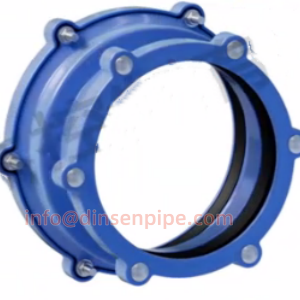
2. F-Type Joint
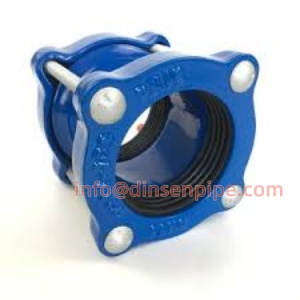
- Structural Features: One end of the joint features a standard EN1092-2 B1 series flange (usually PN10 or PN16 pressure rating), while the other end can be of various types (such as Cantonese, welding, etc.).
- Here, we are discussing removable joints with a flange on one end.
- Working Principle: Bolts and nuts secure the flange end of the joint to the mating flange on another device (such as a valve, pump, or fire hydrant) or pipe (such as steel pipe).
- A flange gasket is installed between the two flange faces to provide a seal.
- Advantages: The joint is highly rigid and can withstand extremely high tensile forces and bending moments. It is easy to disassemble by loosening the bolts, facilitating subsequent maintenance and replacement of the equipment. It is highly versatile and serves as an international standard for connecting equipment of different pressure ratings and materials (such as connecting ductile iron pipe to steel valves).
Post time: Sep-19-2025