In the sealing system of ductile iron pipes, the “soul” of the T-shaped socket joint lies in the tiny rubber ring. Though inconspicuous, it directly impacts the sealing reliability, operational safety, and service life of the entire piping system. The choice of “anti-slip rubber rings” versus “standard rubber rings” has become a hot topic in the industry. This article will provide an in-depth analysis of the core differences between the two, helping you make more informed decisions when selecting the right ring for your project.
Ordinary rubber rings, typically in a standard T-shaped configuration, primarily provide a static seal.
Working Principle: Relying on the inherent elasticity of the rubber, it is compressed between the pipe socket and spigot, creating a tight contact and preventing water leakage and infiltration of soil and groundwater.
Advantages: The technology is mature and cost-effective, providing reliable sealing performance under most common, stable foundation conditions.
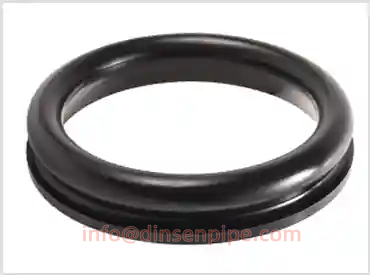
The anti-slip rubber ring is a revolutionary upgrade from the standard T-ring. It not only offers exceptional sealing performance, but also, crucially, features an anti-slip (self-locking) feature, elevating pipe joint security to a whole new level.
Working Principle:
Excellent Sealing: It offers the same or even superior elastic sealing performance as standard rubber rings.
The core feature – the self-locking anti-slip structure – is its most fundamental difference from standard rubber rings. Anti-slip rubber rings typically feature a special “barb,” “fin,” or “anchor” structure on the rear end (near the socket insertion side). When the socket is inserted into the socket and the rubber ring is compressed into place, these special features engage tightly with the locking grooves or roughened surface on the socket’s inner wall, creating a mechanical lock.
Working Process:
During Installation: Under the force of insertion, the anti-slip structure elastically deforms, allowing it to slide in smoothly.
After installation: The anti-slip structure recovers its shape, firmly “anchoring” it to a specific area of the socket. Under tension: When the pipe interface is pulled by external force and attempts to separate the spigot and socket, the ordinary rubber ring may be directly squeezed out, while the anchoring structure of the anti-stripping rubber ring will generate huge reverse friction and mechanical interlocking force, effectively resisting disengagement and ensuring the integrity of the joint.
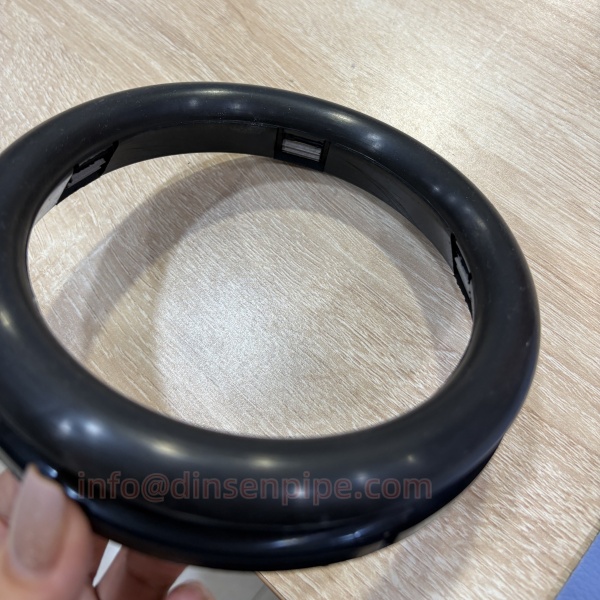
Why choose rubber gaskets?
- Coping with complex geology: In areas prone to uneven settlement, such as soft soil and backfill, anti-slip rubber rings effectively compensate for pipe movement and prevent joint disengagement caused by settlement.
- Improving seismic performance: In earthquake-prone areas, flexible pipe joints must possess sufficient resistance to pullout. Anti-slip rubber rings are a key component in building seismic-resistant pipe networks.
- Ensuring safety in critical areas: In settlement-sensitive areas such as roads, railways, and beneath buildings, using anti-slip rubber rings provides a “safety net” for the pipeline system, preventing secondary disasters such as road collapses caused by joint failure.
- Reducing lifecycle costs: Although the initial purchase cost is slightly higher, it significantly reduces the maintenance, social, and environmental costs associated with joint leakage. In the long run, its comprehensive economic benefits far exceed those of ordinary rubber rings.
rubber gaskets, anti-slip rubber gaskets, anti-slip rubber ring , ductile iron pipes,T-shaped socket joint, T type anti-slip rubber ring
Post time: Oct-27-2025