By Vincent, Quality Engineer | DINSEN
How are ductile iron pipe fittings made? In most foundries, the answer involves two steps: casting the fitting body, then machining a sealing groove into each flange face. DINSEN takes a different route. Our ductile iron pipe fittings are produced with cast-in-place groove casting — a near-net-shape process that forms the sealing groove during pour-off, so no secondary machining is required. The result: better product integrity, shorter lead times and lower cost, validated from DN50 to DN150 in commercial production.
The Challenge: Machined Sealing Grooves Add Cost and Risk
For decades, the sealing groove on a flanged fitting has been machined after casting. It is a reliable process — but it carries real costs.
Machining adds an entire production step. Every flange must be moved from the foundry to the machine shop, clamped, cut and inspected, consuming labor, machine time and energy on each fitting.
Machining also creates a thermal gradient. Removing material leaves local section-thickness variations that disturb solidification and feeding, raising the risk of micro-shrinkage and porosity near the flange.
And machined grooves mean extra work-in-progress inventory and extra quality checkpoints — more working capital tied up, and more chances for human error.
The Solution: Near-Net-Shape Casting Eliminates Machining
Near-net-shape casting forms the sealing groove directly in the mold, so the groove solidifies together with the fitting body. No secondary material removal. No added thermal gradient. No inter-plant handling.
How the Process Works
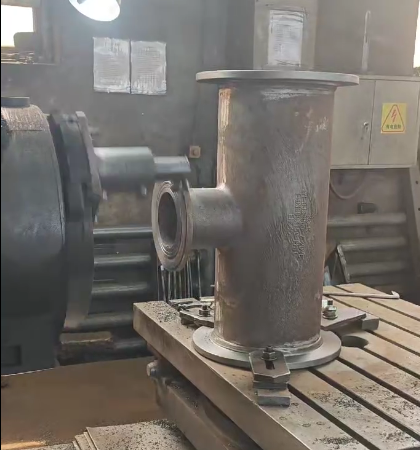
The innovation lives in the core assembly. Traditionally, the flange core consists of three interlocking parts, designated A, B and C. DINSEN engineers machine a pre-formed groove contour into the outer surface of Core B before assembly. When the mold is poured, both the bolt-hole pattern and the sealing groove take shape as an integral part of the flange.
Precision Fit: Guide Slots and Anti-Misalignment Features
Because groove geometry depends on core position, accuracy starts at assembly. Guide slots and anti-misalignment features lock the three core parts together, guaranteeing repeatable assembly precision from one mold to the next. The measured result: groove depth, width and concentricity that consistently meet or exceed standard requirements.
Faster Validation with 3D Sand Printing
Prototyping used to require expensive pattern tooling. With binder-jet 3D sand printing, prototype core sets are produced in days instead of weeks. Designers validate groove geometry, gating and feeding before committing to production tooling — significantly shortening development cycles for new fitting configurations.
Proven in Production: DN50 to DN150
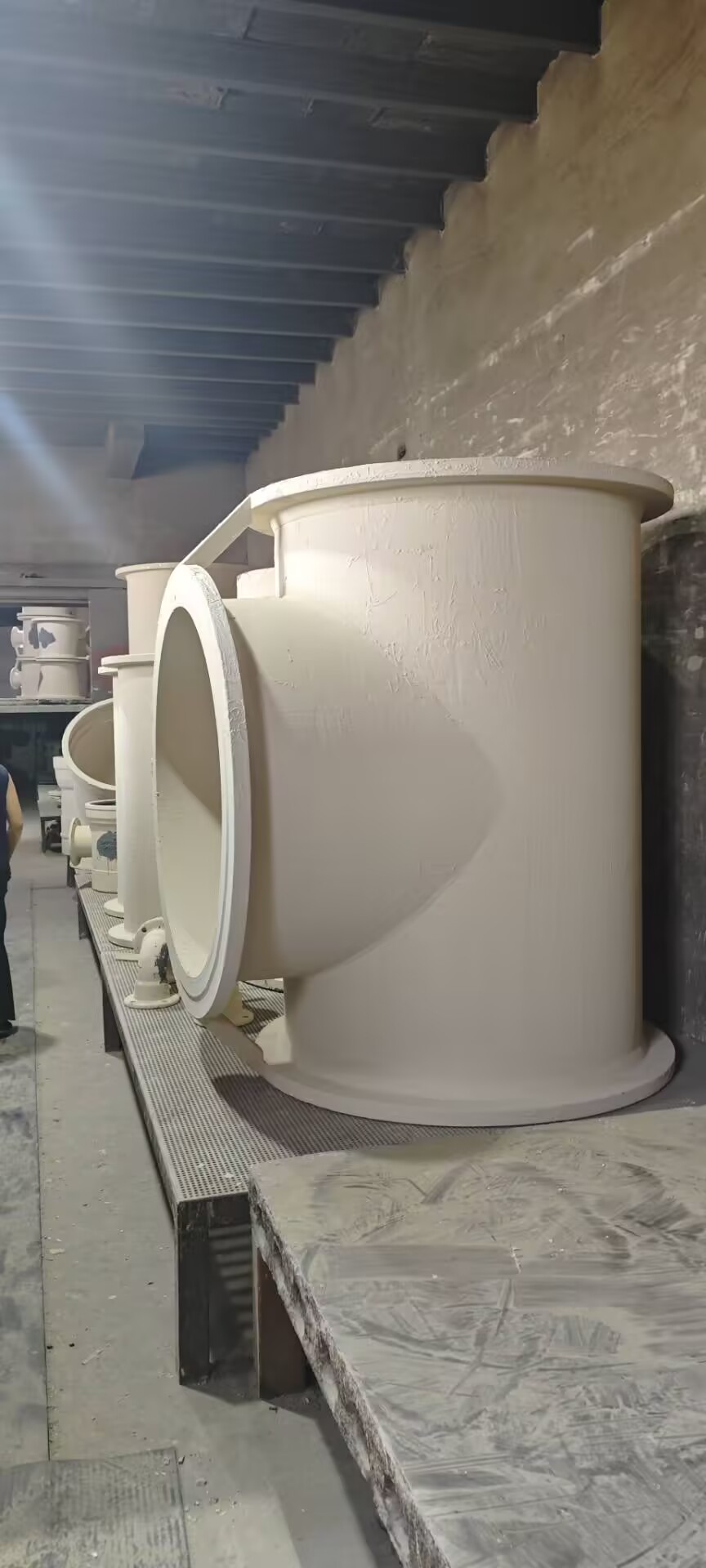
After shakeout and shot-blast cleaning, the cast flange faces show groove dimensions — depth, width and concentricity — that consistently meet or exceed standard requirements, with no measurable loss of quality. Cast-in-place grooves have been validated across DN50 through DN150 in commercial production, delivering the same or better sealing performance than machined grooves on EN545 ductile iron pipe fittings.
Five Measurable Benefits of Cast-In-Place Grooves
| Benefit | What changes | Measurable impact |
| Product integrity | No machining-induced thermal gradient; better feeding during solidification | Fewer micro-shrinkage and porosity defects; superior pressure-retaining capability |
| Production speed | Machining step removed; finishing operations reduced | Compressed manufacturing timeline; less work-in-progress inventory |
| Cost reduction | Less molten metal consumed; less machine tool usage; no inter-plant handling | Higher material utilization; lower energy, tooling wear and labor overhead |
| Working conditions | Fewer grinding and finishing steps | Lower shop-floor dust and noise levels |
| Process simplicity | Fewer steps and quality checkpoints | Higher process capability; fewer human errors |
The same philosophy extends beyond grooves. Our Grip E locking coupling installs without specialized tools, cutting construction labor by up to 30% compared with conventional solutions — another example of engineering that reduces work at the job site instead of adding it.
Frequently Asked Questions
1. What is a sealing groove on a ductile iron flange?
A sealing groove is a circular recess in the flange face that houses a gasket or O-ring. When two flanges are bolted together, the gasket compresses inside the groove to create a leak-tight joint.
2. Why are sealing grooves usually machined?
Machining has been the conventional method because it is precise and well understood. Its drawbacks are cost, lead time and the risk of defects introduced by removing material after solidification.
3. How does cast-in-place groove casting work?
The groove contour is built into the flange core — Core B of a three-part core assembly. During pour-off, the groove forms together with the fitting body, so the flange needs no machining afterwards.
4. What size range is available?
Cast-in-place sealing grooves have been validated from DN50 to DN150 in commercial production, with groove depth, width and concentricity equal to machined equivalents.
5. Does cast-in-place affect pressure rating or sealing performance?
No. Because the groove forms during solidification, there is no thermal gradient and no section-thickness variation. In fact, reduced micro-shrinkage improves pressure-retaining capability.
6. Can I get prototypes before mass production?
Yes. Using 3D sand printing, we produce prototype core sets quickly for design validation before committing to production tooling.
About DINSEN — Ductile Iron Pipe and Fitting Manufacturer
DINSEN is a world-class supplier of ductile iron pipes, pipe fittings and couplings, with manufacturing facilities in Handan, Hebei Province. Products comply with ISO 2531, EN 545, EN 598 and AWWA standards, backed by an ISO 9001:2015-certified quality management system. With projects in more than 50 countries — Southeast Asia, the Middle East, Central Asia, Europe and the Americas — DINSEN also supplies EN877 cast iron soil pipe fittings for building drainage systems. Learn more about DINSEN.
Get a Quote
Planning a municipal water, drainage or industrial pipeline project? Our engineers will help you select the right fittings, sizes and coatings — with free samples, third-party inspection and fast delivery. Contact DINSEN for a free quote.
Post time: Aug-21-2026